TLDR:

The Utah Legislature has passed several state laws in recent years that amend the Utah Municipal code in ways that some may suggest allow developers to bypass local control.
Supporters insist that these laws work towards achieving Governor Cox’s goal of building 35,000 starter homes in Utah by December 2028. With an estimated 6,000 to 7,000 units already completed or underway as of March 2026, the plan is already way behind schedule.
Municipalities and counties face the challenge of growing infrastructure with housing supply, with additional sewage treatment plants, water lines & transportation needed to support higher population densities. However, despite positive recommendations from local planning commissions & staff, county councils are hesitant to approve high density, mixed-use developments that have negative public sentiment (e.g., UOP, Junction Commons).
We outline below the key state laws that have been passed that affect land use control, zoning & development.
Making subdivisions an administrative process
Utah SB 174 and HB 476, passed in the 2023 and 2024 General Sessions, shifted the review process for residential subdivisions from a legislative to administrative process. They limit the number of review cycles to a max of 4 and restrict the number of public hearings in order to shorten the application process. They also require approval by an administrator (like a planning director), bypassing city council or planning commission review.
The role of planning commissions is now reduced to holding public hearings for “preliminary subdivisions”, and county staff have the final say in approving or denying the final subdivisions. A preliminary subdivision at Blue Sky in Wanship in Summit County was approved in 2025 under this new process after an initial rezoning request failed to move forward.
Overcoming local land use authority with transit hub zones & preliminary municipalities
The introductions of SB 84 and SB 26, passed in 2023 and 2025 General Sessions, were meant to accelerate affordable housing development near transit hubs, encouraging mixed-used projects within a quarter mile of transit in Housing and Transit Reinvestment Zones.
Critics have accused state legislators of passing SB 84 specifically for Dakota Pacific’s proposed development in Kimball Junction, near the transit hub. Summit County sued the state over SB 84 in 2023 and won when the 3rd District Court ruled that SB 84 did not apply to the Dakota Pacific property. However, the county did not pursue further legal action with SB 26. Why not? Perhaps because a new law SB 258, passed in 2024, allowed Dakota Pacific to proceed with development.
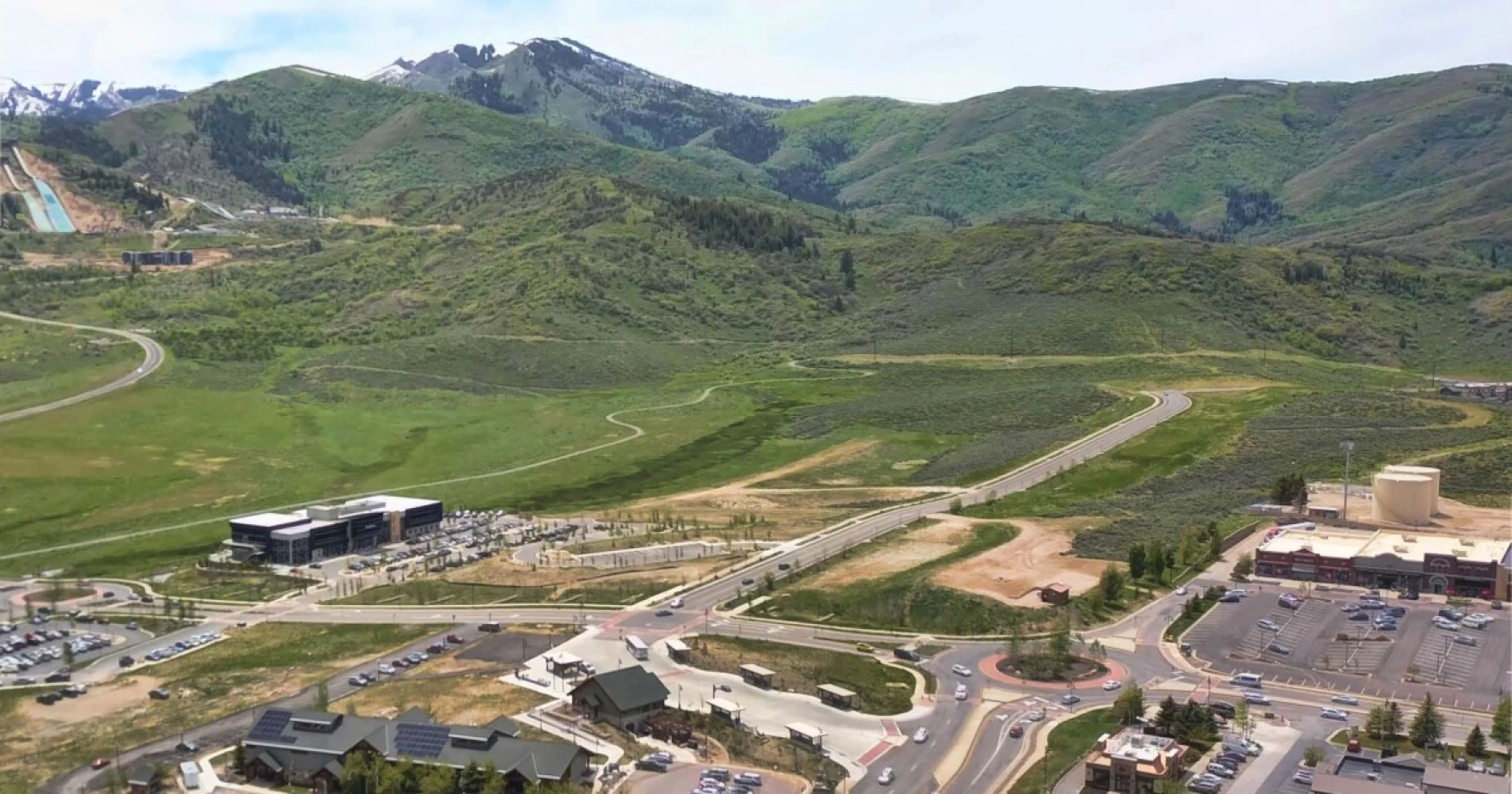
SB 258 establishes a pilot program allowing landowners of unincorporated land to create a “preliminary municipality” that can then act as a temporary governing body, controlling zoning & land use. Preliminary municipalities are approved by the Utah Lieutenant Governor’s office. They must be owned by no more than 3 people, must be contiguous within ¼ mile of a municipality and must transition to a town within 6 years with at least 100 residents at time of incorporation. Only 2 applications per calendar year can be approved by the lieutenant governor. Dakota Pacific filed a petition for a preliminary municipality with Utah’s Lieutenant Governor’s office in early 2025.
Other developments that have filed for preliminary municipality petitions in Summit & Wasatch Counties include:
- Lost Creek Development in Browns Canyon: Filed in early 2026 but rejected since the max number of filings had already been received by the lieutenant governor. Ivory Homes can now only execute on their high density mixed-use housing plans with a rezone.
- Wasatch Highlands, east of Heber City: Allowed to proceed with a feasibility study in 2026. This is after a failed attempt to annex the proposed development to Heber City and Wasatch County council's opposition to the plan.
- Bear Canyon in Wasatch County: Need to resubmit their application since the number of landowners exceeds the limit of 3.
Key Takeaways
Nonprofits in Moab, Grand Country, have
sued the state & a developer in the 7th District Court in February 2026, claiming that the Echo
Canyon development’s preliminary municipality status is unconstitutional.
What’s clear is that Summit County does have a housing need especially for local workforce who often
reside in other counties. A common concern against high density housing is traffic congestion.
One could argue higher population density concentrated in an area contributes to more traffic, but
one could also point out that daily commutes from other counties contribute to traffic as well.
It’s just unfortunate that planning decisions are now being determined by the judiciary instead of local
development code. But it’s also unfortunate that local politics is preventing land use regulations
from being applied as recommended by planning staff.