TLDR:
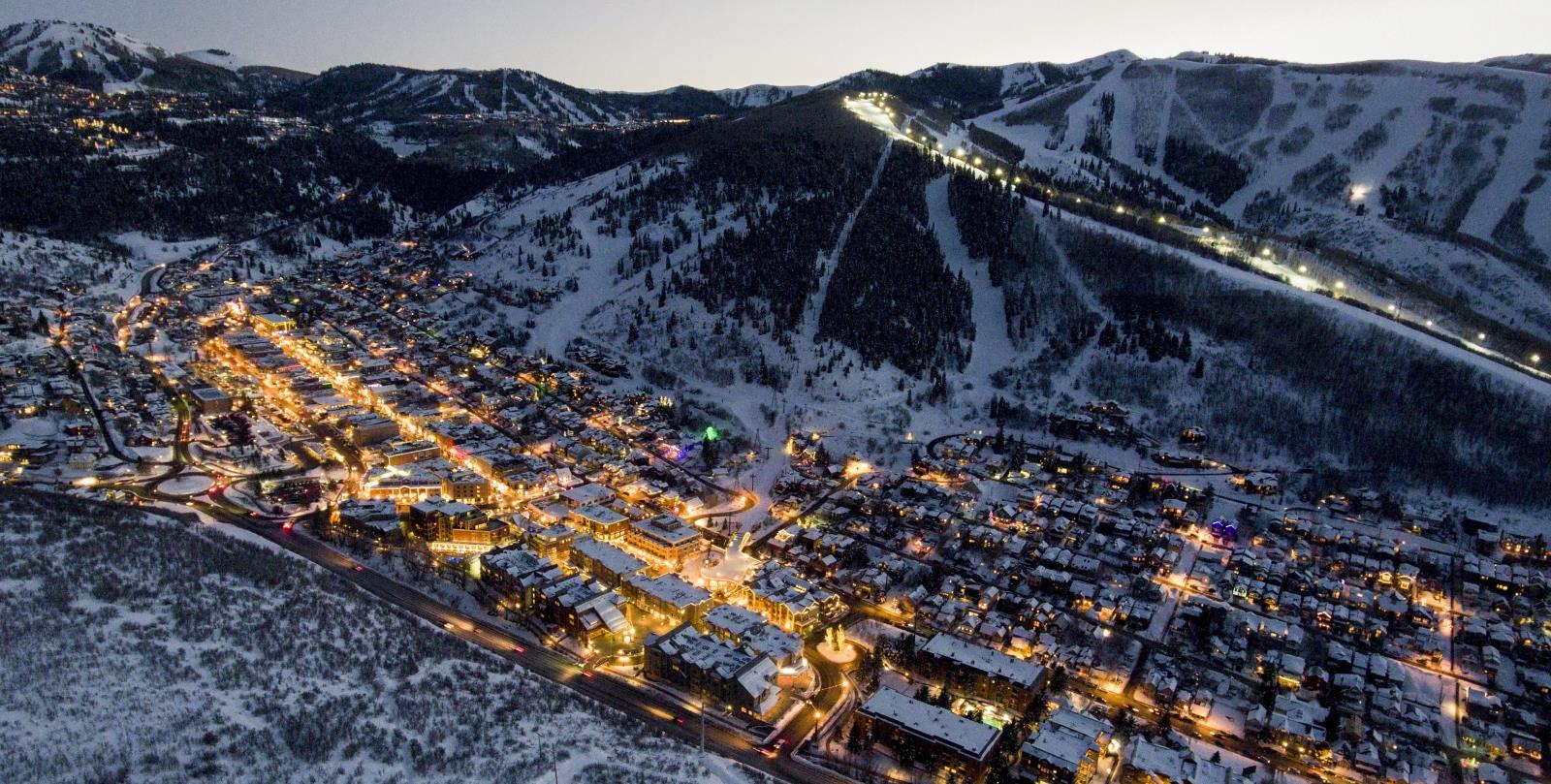
What's the Land Management Code?
The Land Management Code, which is a part of Park City's Municipal Code, defines zoning districts and rules for each district for lot size, building envelopes, max building height, setbacks, parking and allowed uses. Note that a parcel may have multiple zones that apply to it as well as overlays.
A lookback on historical trends in code changes...
Amendments to the Land Management Code have been the 3rd most common planning application type over
the last 3 years of Planning Commission agendas. Half of the 76 occurrences of code amendments had
references to zoning districts, and the 3 most common zones were
General Commercial,
Light Industrial,
and
Historic Residential - 1.
These zoning districts correspond to the Bonanza Park, Upper / Lower Iron Horse Loop Rd area, and
the residential part of Old Town west of Main St, respectively. We'll dive deeper in the next section
why General Commercial & Light Industrial zones have been so popular for code amendments when we
review recent rezoning trends.
Applying text mining to the agenda item descriptions, we found that the 3 most common amendment purposes were about parking & transportation, rezoning / zone changes, and accessory uses in Master Planned Developments. This coincides with the growing pains that Park City is experiencing with traffic during the winter season (now also getting worse in the summer months) and an increased demand for accessory uses, e.g. accessory apartments, in a tight housing market.
Rezoning Trends
The following areas of Park City have been under active discussion for rezoning:
-
Bonanza Park:
This area was historically an industrial mining & rail yard which is now a commercial district zoned
for General Commercial use. The city
purchased a 5.25-acre Bonanza Park parcel in 2017 for $19.5M, initially for an arts & culture
district with the Kimball Art Center & Sundance Institute as anchors, though this eventually evolved
to focus on mixed-use housing & retail development (the Sundance Institute decided to
move to Boulder, CO in March 2025 and the Kimball Art Center decided to
move to Kimball Junction in July 2025).
After a 2-year public process, City Council adopted the
Bonanza Park Small Area Plan
on July 11, 2024 to guide future development of a broader 200-acre area with a vision of a walkable, mixed-use district
with density, public art & affordable / workforce housing.
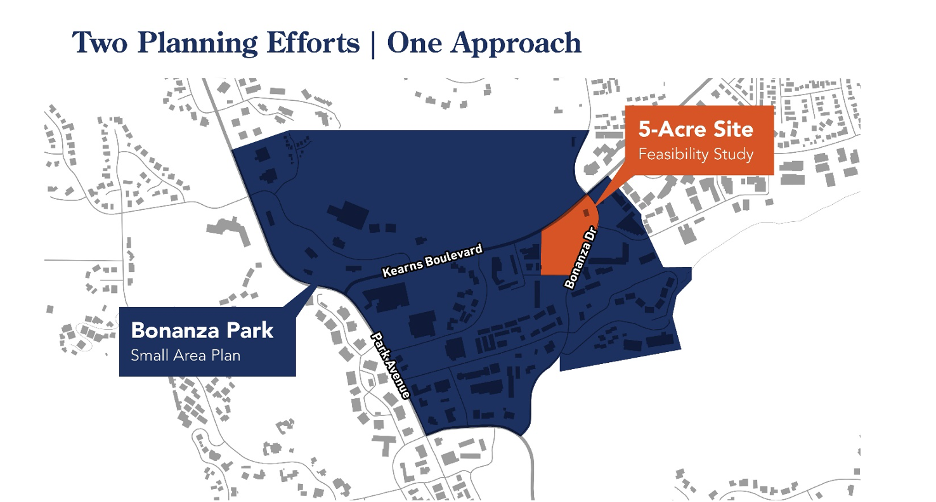
Image from Bonanza Park project site
2025 brought about discussions to review feasibility studies conducted in 2024, select Brinshore Development as the developer, and define the new Bonanza Park Mixed-Use (BPMX) zoning. The new BMPX zoning would replace portions of the existing General Commercial code and Affordable Master Planned Development with updated standards. Key features of the new zoning include allowing increased building height (up to 45ft from the existing 35ft), increased density allowances, reduced setbacks, reduced parking requirements, particularly for developments close to transit stops. The open space requirements would be eased from 30% to 20% to improve development feasibility, and new incentives for mixed-income housing would be introduced. The updated BMPX code would broaden permitted uses to child care, small-scale manufacturing, public art and "green community spaces".
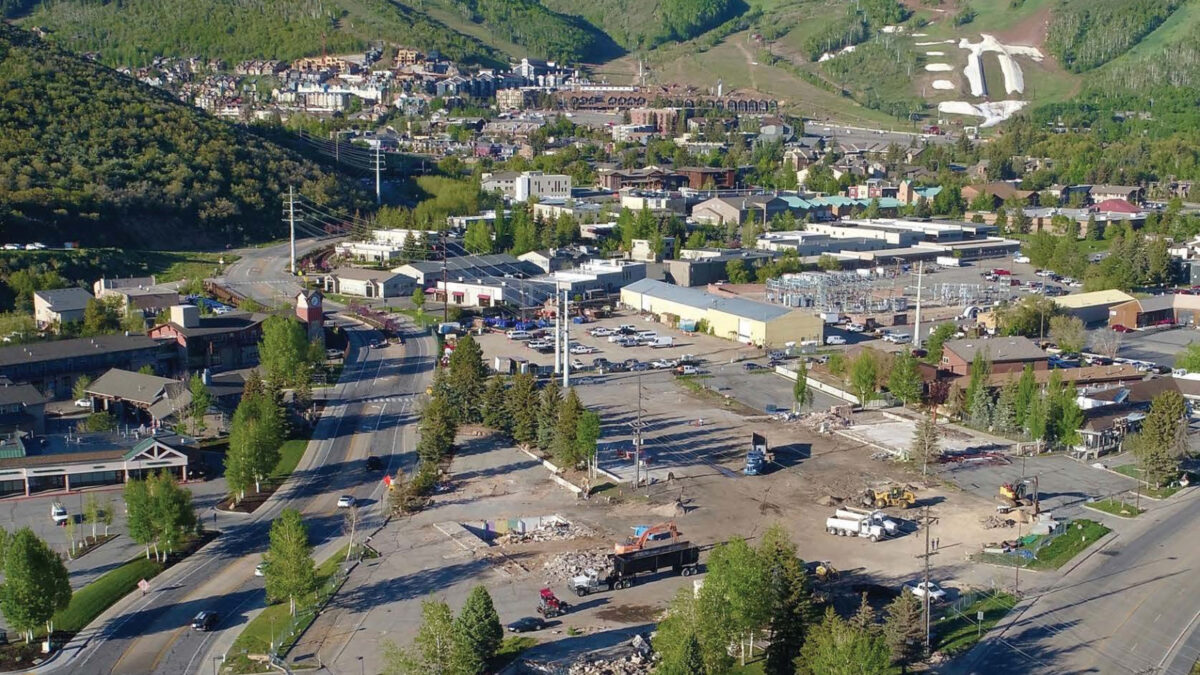
Photo from Park City Municipal
This new zoning would be applicable to approximately 70 acres of the Bonanza Park core in Phase 1 of the BPMX implementation, with potential for expansion to the larger 200-acre area in subsequent phases.
The Planning Commission plans to work on an application in 2026, which will include a site tour and a series of discussion meetings. Before contractors can be chosen, City Council must approve a pre-development agreement & financing details. The Brinshore Development 5-acre Bonanza Park project is projected to cost ~$120M, with Park City contributing up to ~$30M.
-
Clark Ranch: This is 344 acres of open space, straddling US-40, close to Park City Heights
& Quinn's Junction, with dozens of miles of recreational trails. Park City purchased this property
for over $6M in 2014 using Resort Communities Tax funds, annexed the parcels into Park City and
zoned them for
Recreation & Open Space with
Sensitive Land Overlay in 2021.
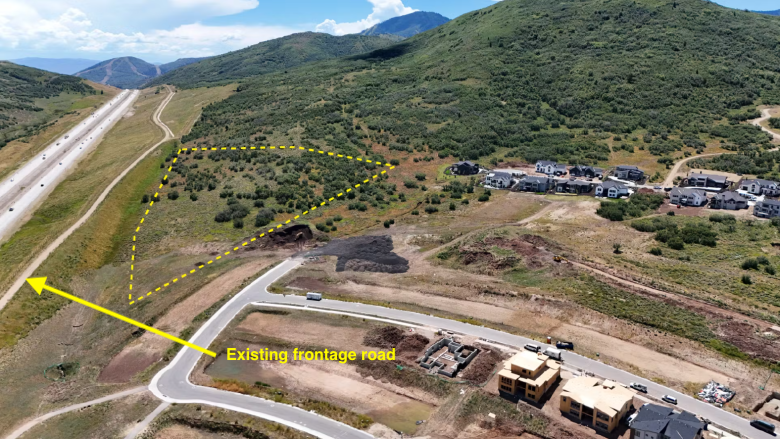
Photo from Clark Ranch project site
In 2022, Park City issued an affordable housing feasibility study RFP and awarded the contract to Stereotomic in 2023. The city issued an RFP for a Clark Ranch developer in March 2024, selected the Alexander Company in early 2025, and engaged WSP (for up to $725k) for engineering design service for a new frontage road. The development project seeks to rezone 10 acres of Clark Ranch with the following considerations:
- 3 multi-unit dwellings, each with a first-level shared garage structure, and two levels of residential units above (Phase I) and 34 two-story townhomes (Phase II), resulting in a total of 201 dwelling units
- 167 units of rental multifamily housing, 34 units of for sale housing (townhomes). This density of 201 units over 10 acres is far higher than that of neighboring Park City Heights but more similar to the density of nearby Studio Crossing (208 affordable rental units + 110 market-rate for-sale units = 318 units over 18.45 acres).
- 2 buildings will be for Low-Income Housing Tax Credit program, a federal program for households earning 50-70% of area median income (AMI). This is $59K-$82.6K for a 1-person household in Summit County.
- 3rd building will be housing for people with higher AMIs, i.e., market-rate townhomes
- Targeted to full-time workers in Park City, not seasonable workers, e.g., prioritization of housing for municipal employess + frontline workers
- Prioritization of multi-modal transportation & connections to transit
- Residential units & amenity spaces to be stacked on top of parking to minimize land disturbance
- Area just south of Park City Heights is being considered for the housing project and are on Steep Slopes between 15%-30%. The site has slopes 0%-30%, with an average slope of 20%. As a comparison, Park City Heights has slopes of 10%-20%.
- New frontage road to west of US-240 is needed for development access (approximate cost for 0.7-mi-long road was $5M in 2025; the Stereotomic feasibility study in 2023 estimated this cost would be $1.3M & that an additional $8.6M would be needed for streets, utilities & retaining walls). Note that the frontage road is owned by Utah Department of Transportation. An access road connection from the frontage road to the Very Steep Slopes on the site will also be needed.
- Stormwater retention ponds are needed for the site to manage storm runoff & prevent downstream flooding
- Sensitive Land Overlay has requirements to be met & a wildlife habitat assessment will be required
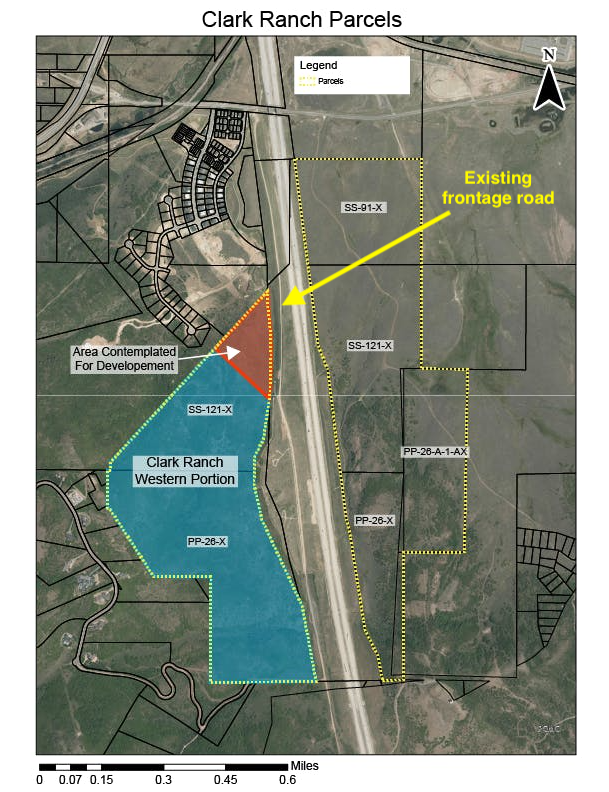
Parcel map from Clark Ranch project site
In December 2025, City Council approved a conservation easement for Clark Ranch, protecting 329 acres as open space, with the remaining 15 acres being considered for housing project development. Only 10 acres will be used for development & the remaining 5 acres will be designated as open space. The conservation easement is enforced by Utah Open Lands.
The application to rezone the Clark Ranch parcel from Recreation & Open Space to Residential Development - Medium for an Affordable Development is still to be approved by City Council. An Affordable Housing Overlay or a new zone designation will need be introduced by the Planning Commission & approved by City Council. A Zone Change & a Subdivision review will need to be approved in 2026 before the developer can request a Master Planned Development & a Conditional Use Permit.
The cost of the Clark Ranch project is projected to be anywhere from $60M (90 units) to $80-$100M (230 units), not including land purchase & infrastructure cost (which will be paid for by the city). The city initially earmarked $8M to help start the project, but given the frontage road cost estimates from 2023 increased in 2025, it is likely that more will be needed. The primary challenge of the Clark Ranch project will be developing medium-density housing on Steep Slopes and Very Steep Slopes and building infrastructure (roads, utilities, retaining walls, retention ponds) while ensuring costs do not balloon as costs of construction & materials continue to increase.
-
Iron Horse Loop: There was an application in 2025 for a zone change for 1885 Lower Iron Horse Loop
from
Estate
to Light Industrial for the construction of an Affordable Master Planned Development. Owned by Nani
Investment LTD, this parcel lies also in the Bonanza Park overlay zone, is next to the Rail Trail and
is adjacent to the Light Industrial Zoning of Iron Horse Loop.
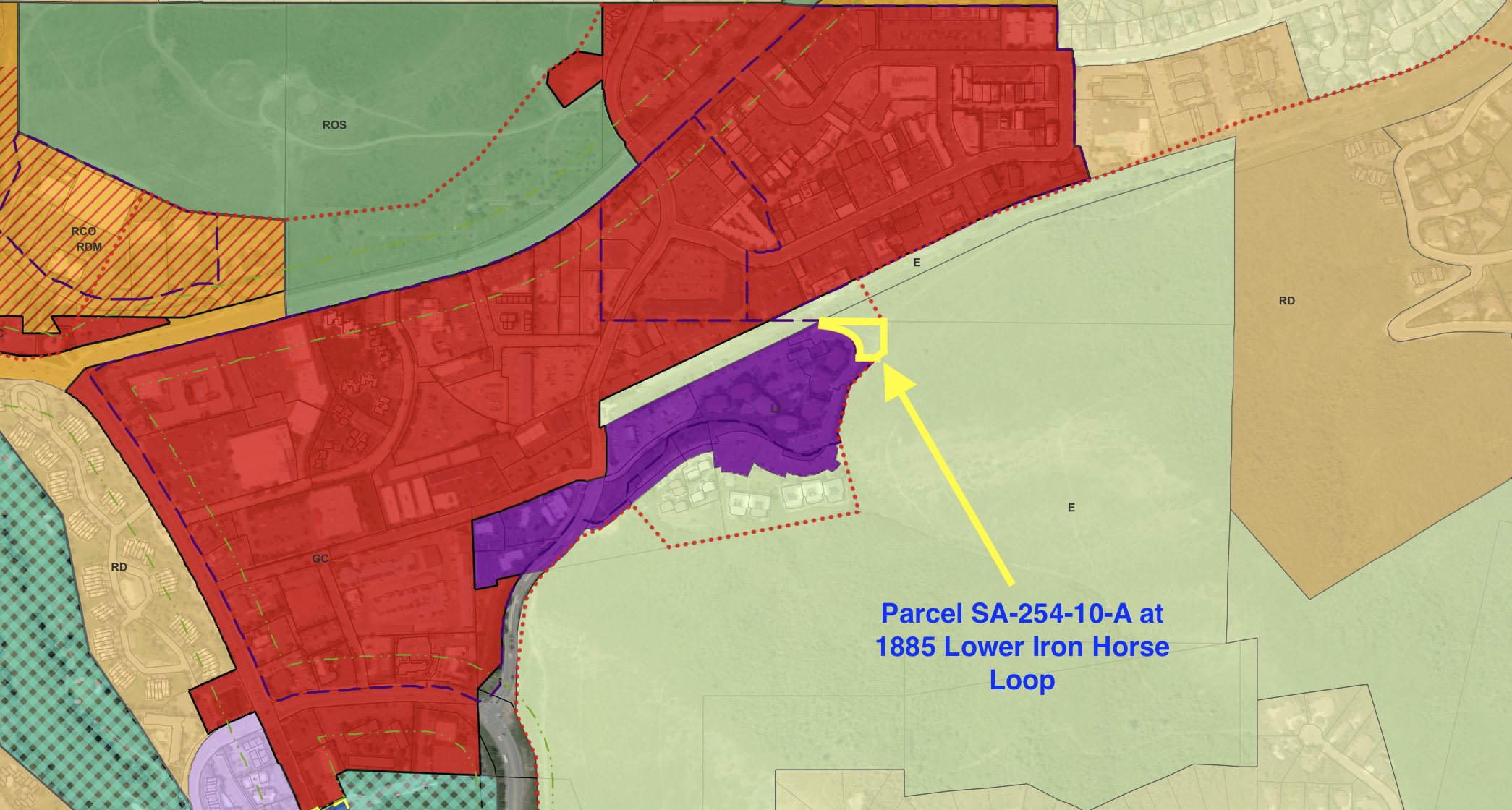
Iron Horse Loop parcel map
The proposal is in the pre-application stage for an Affordable Master Planned Development of 23 units for the 0.54 acre parcel, with building height of up to 45 ft & parking along Lower Iron Horse Loop. Note that the Light Industrial zoning height limit is 30 ft. Meeting minutes from the July 9, 2025 Planning Commission meeting revealed concern around the following topics:- Property access & impact on the Rail Trail trailhead & trail running through the property
- Overlap of FEMA floodplain in part of the parcel & the required buffering
- Setback determination from Silver Creek required by State regulators
- Construction on Very Steep Slopes
There was also an application in 2024 to rezone a lot at 1460 Eagle Way in Aerie / Masonic Hill from Single Family and Estate to exclusively Single Family, and this was successfully changed to match the zoning of other lots on Eagle Way.
Key Takeaways
Park City's Land Management Code, which is part of the Municipal Code, defines zoning districts & specifics
rules for each district such as lot size, building envelopes, max building height, setbacks, parking and
allowed uses.
As the town has evolved, changes to the Land Management Code have been made to adjust accordingly, and
these have included rezoning of parts of Park City to accommodate development of affordable housing,
addressing a pressing need for local workforce. It's clear that projects on city-owned land that are
driven by the city will eventually get rezoned, so it's important residents speak up & voice their
thoughts during public hearings in the hopes of shaping the process. Private firms developing on
privately-owned land will likely need to find a way to partner with the city for their project to
ensure interests are aligned for a higher probability of success.
It is undeniable that housing for local workforce needs to be addressed, especially in a town
where it was recently reported that
56.5% of houses in Park City proper are "vacant". Layer on top of that, residents from city-funded
& city-backed affordable housing units have reported issues with
high maintenance & repair costs, as well as safety concerns. Definitely expect to see more
developments on rezoning proposals in 2026.